How Contracts for Difference (CfDs) Work for Energy Suppliers
Contracts for Difference (CfDs) are a key part of the UK’s approach to supporting low-carbon electricity generation while protecting consumers from volatile energy prices. Although CfDs are often discussed in relation to renewable energy developers, they also play an important role in how energy suppliers are charged and how costs are passed through to consumers.
This page explains what CfDs are, how they work, and what they mean for energy suppliers.
What Is a Contract for Difference?
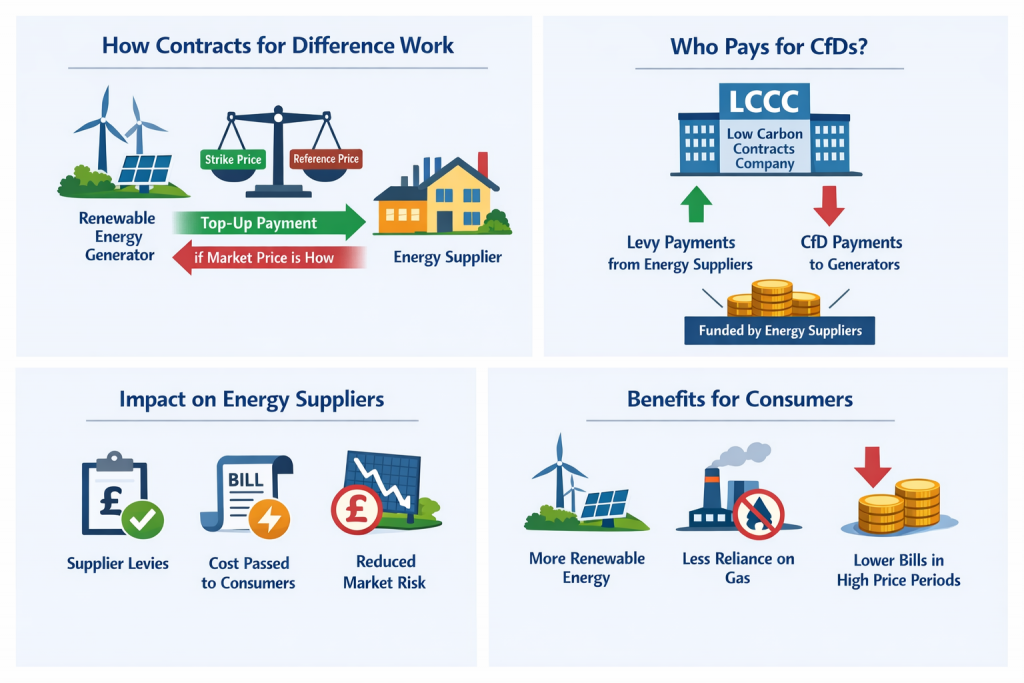
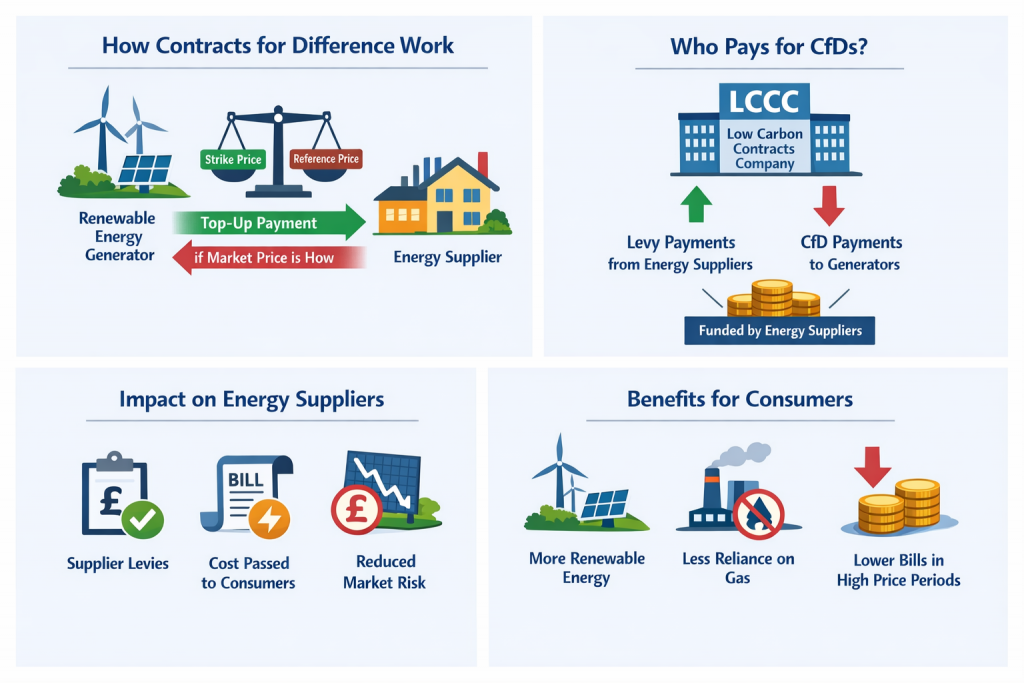
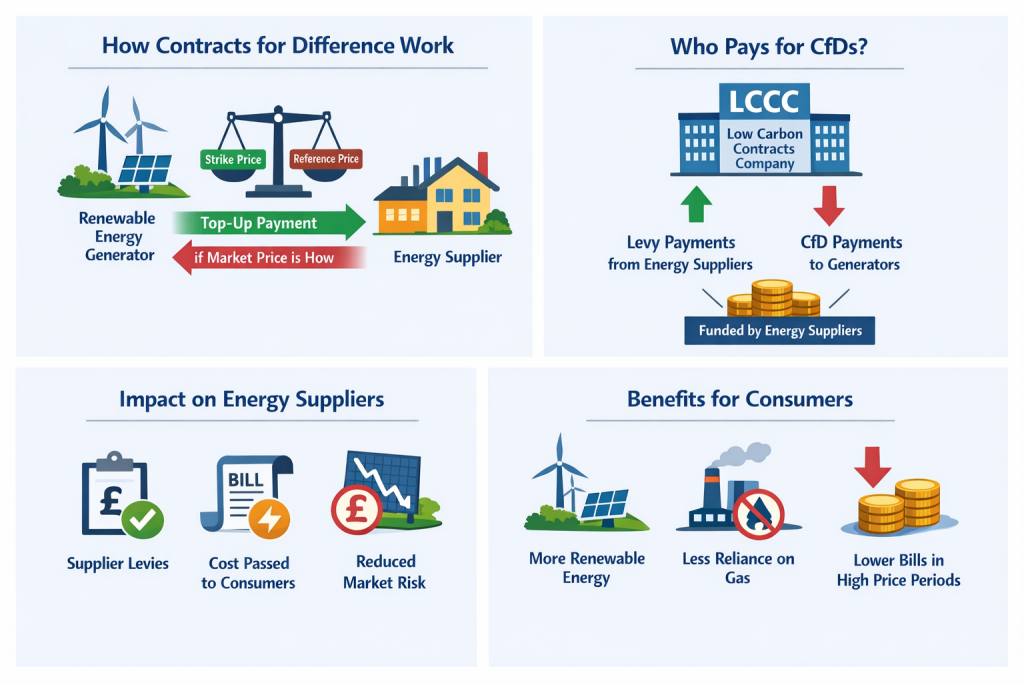
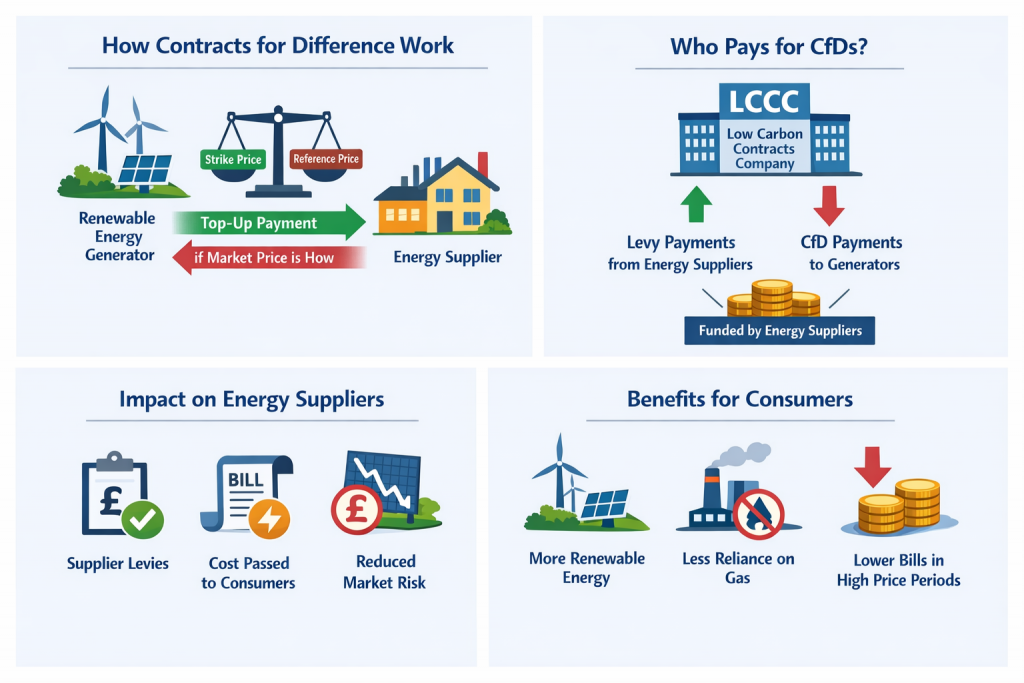
A Contract for Difference is a long-term agreement between a low-carbon electricity generator and the UK government, designed to provide price stability for electricity generation.
Under a CfD, generators are paid a fixed price for the electricity they produce, known as the strike price. This helps developers invest in renewable technologies such as offshore wind, onshore wind, solar, and nuclear by reducing exposure to wholesale market volatility.
How CfDs Work in Practice
CfDs operate by comparing the strike price with the reference price, which reflects the average wholesale market price of electricity.
- If the market price is lower than the strike price
The generator receives a top-up payment to make up the difference. - If the market price is higher than the strike price
The generator pays back the difference.
This two-way mechanism ensures generators receive a stable income while protecting consumers from overpaying when market prices are high.
Who Pays for CfDs?
While CfDs are contracts between generators and the government, energy suppliers ultimately fund CfD payments.
Payments are managed by the Low Carbon Contracts Company (LCCC), a government-owned company. The LCCC collects money from licensed electricity suppliers to cover payments owed to generators under CfDs.
Suppliers then recover these costs through customer electricity bills.
How CfDs Affect Energy Suppliers
Energy suppliers do not directly enter into CfD contracts, but they are financially responsible for funding them. This affects suppliers in several key ways:
1. Supplier Levies
Suppliers pay a CfD Supplier Obligation Levy, calculated based on the amount of electricity they supply to customers. The more electricity a supplier sells, the greater their contribution.
2. Cost Pass-Through to Customers
Most suppliers pass CfD costs on to consumers as part of electricity tariffs. While this increases bills slightly, CfDs are designed to reduce long-term costs by stabilising prices and encouraging cheaper renewable generation.
3. Reduced Wholesale Price Risk
When market prices rise above strike prices, generators pay money back into the system. These payments reduce the overall levy charged to suppliers, helping offset high wholesale prices.
CfDs and Consumer Energy Bills
Although CfDs add a line item to supplier costs, they can lower consumer bills over time by:
- Increasing the share of low-cost renewable electricity
- Reducing reliance on gas-fired generation
- Returning money to consumers during periods of high wholesale prices
For example, during periods of high gas prices, many CfD-backed generators have paid substantial sums back into the system, easing pressure on supplier costs and bills.
Why CfDs Matter for the Energy Market
CfDs play a central role in the UK’s energy transition by:
- Encouraging investment in clean energy
- Providing price certainty for generators
- Shielding suppliers and consumers from extreme price swings
- Supporting long-term energy security
The scheme is a cornerstone of the UK’s strategy to reach net-zero emissions while maintaining a competitive electricity market.
Summary: CfDs and Energy Suppliers
- CfDs guarantee a stable price for low-carbon generators
- Energy suppliers fund CfD payments via a levy
- Costs are usually passed through to consumers
- When market prices are high, CfDs can reduce supplier costs
- Over time, CfDs help stabilise electricity prices and support cleaner energy